
The Kaziranga Miracle: How Political Will Rescued the One-Horned Rhino
INDIA
2/27/20262 min read
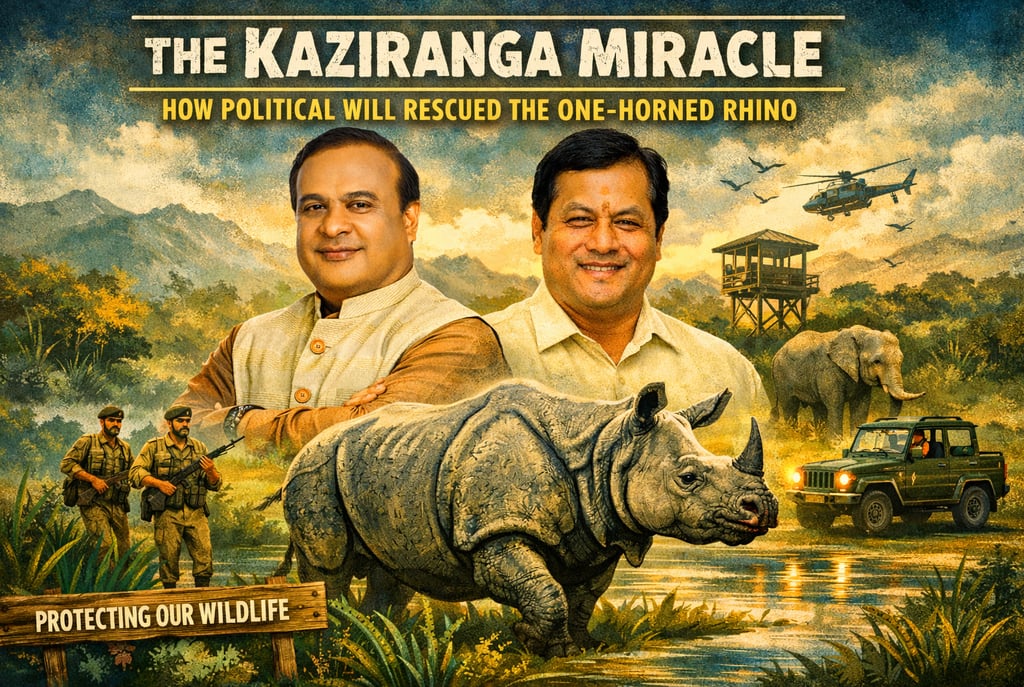
Kaziranga National Park is no longer just a wildlife sanctuary. It has become a political case study in how leadership styles influence conservation outcomes. Kaziranga National Park has long been a symbol of India’s conservation success, particularly for the iconic one-horned rhinoceros. Yet, just a decade ago, the park was plagued by a grim reality—rampant rhino poaching that threatened to undo years of wildlife protection. Today, Kaziranga’s narrative has shifted dramatically from a poaching crisis to a conservation turnaround, proving that when political will aligns with ground-level enforcement, miracles can happen.
The Dark Days of Poaching (Pre-2016) :
For over a decade under the Congress-led government, Kaziranga faced a period characterized by administrative apathy. Under the tenure of then-Forest Minister Rakibul Hussain, the system struggled significantly to contain organized wildlife crime. The statistics from this era are deeply troubling:
In 2013, approximately 27 rhinos were poached.
The following year, 28 rhinos were killed.
In 2015, another 17 rhinos were lost to poachers.
During this time, anti-poaching operations lacked technological modernization, and intelligence gathering was weak. Current Chief Minister Dr. Himanta Biswa Sarma has even publicly alleged that a "poaching syndicate" existed during this era, operating with such brazenness that it pointed to a total collapse of enforcement. While conservation was an official priority on paper, the reactive approach left the rhinos highly vulnerable to sophisticated international syndicates.
A Shift in Strategy and Outcomes (Post-2016):
The turning point arrived in 2016 with the change in government. The new BJP administration, initially under Sarbananda Sonowal and later Dr. Himanta Biswa Sarma, overhauled the conservation philosophy, shifting from a reactive model to a proactive, militarized one.
The government enforced a strict "Zero Tolerance" policy. This aggressive strategy included a shoot-at-sight policy against armed poachers inside protected zones, the deployment of drones and modern surveillance, and the formation of a Special Rhino Protection Force (SRPF). The administration also sent a powerful symbolic message in 2021 by publicly burning 2,479 seized rhino horns to destroy the myth of their medicinal value.
The results of this intense administrative focus are undeniable:
Official data shows an 86% drop in rhino poaching since 2016.
In 2022, Assam recorded zero poaching for the first time in 45 years.
Today, Kaziranga hosts over 2,600 rhinos, the highest concentration globally.
Battling the Narrative: Global Media vs. Reality:
Despite these monumental successes, the global media narrative hasn't always been supportive. In 2017, a BBC documentary titled Killing for Conservation criticized the state's shoot-at-sight policy, framing the anti-poaching efforts through the lens of human rights concerns. This drew sharp criticism for being a one-sided narrative that sympathized with armed poachers while undermining the morale of the forest guards who risk their lives daily. Consequently, the National Tiger Conservation Authority (NTCA) banned the BBC from tiger reserves for five years.
Fortunately, other international voices recognized the reality on the ground. British cricketer and conservationist Kevin Pietersen visited Kaziranga in 2020 and lauded Assam as a "global leader in rhino conservation". By highlighting the bravery of frontline staff, including the female forest guards (Van Durgas), Pietersen validated that the "Assam Model" is a blueprint for the rest of the world.
Conclusion
The story of Kaziranga is a testament to what happens when a government prioritizes its natural heritage. While no conservation model is completely beyond scrutiny, it is crucial to recognize measurable progress. The transition from the neglected crisis years to today's secure sanctuary is an undeniable story of recovery and resilience that deserves fair evaluation and global celebration.
Contact
Reach out for news tips or inquiries.
Phone
+91-6003712563
© 2025. All rights reserved.