
PM Narendra Modi’s Assam Visit Signals New Momentum for Development, Connectivity and Welfare
INDIA
3/13/20263 min read
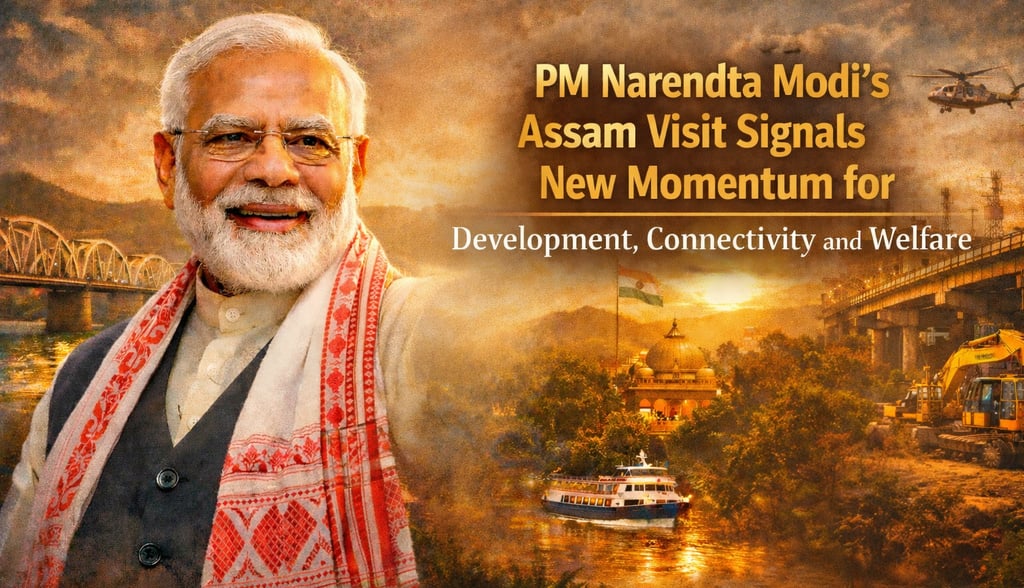
Guwahati, March 13: Prime Minister Narendra Modi’s two-day visit to Assam on March 13 and 14 has reinforced the Centre’s strong commitment to the state’s growth story, with a massive development package covering roads, railways, energy, agriculture, tourism and welfare. The visit is being seen as a major boost for Assam’s infrastructure transformation and a clear reflection of the importance the Modi government places on the Northeast, especially Assam.
With projects worth over ₹47,000 crore linked to the visit, the Prime Minister’s programme spans Kokrajhar, Guwahati and Silchar, touching multiple regions of the state and bringing both immediate benefits and long-term growth opportunities. The scale of the announcements underlines the government’s focus on balanced regional development, improved connectivity and stronger economic foundations for the people of Assam.
A key highlight of the visit is the government’s continued emphasis on road and transport infrastructure. In Kokrajhar, the launch of Assam Mala 3.0 and several road projects in the BTC region marks another major step toward modernising Assam’s connectivity network. Better roads, bridges and flyovers are expected to reduce travel time, improve trade movement and make daily life easier for lakhs of people. The inclusion of the Bodoland region in this major development push also sends a strong message of inclusive growth and stability.
The rail sector too has received a major push. New train services and railway upgrades announced during the visit are expected to strengthen Assam’s connection with the rest of the country while improving internal mobility in the Northeast. Such projects are not only about transport—they open the door to economic activity, employment generation and greater integration of remote areas into the national growth framework.
In Guwahati, the Prime Minister’s agenda reflects the Modi government’s dual focus on infrastructure and welfare. The distribution of land pattas to tea garden workers stands out as a landmark step. For thousands of families from the tea community, land rights represent dignity, security and access to a better future. This move is likely to have a deep social impact, empowering a historically important community that has contributed immensely to Assam’s economy and identity.
The release of the latest PM-KISAN instalment during the visit further strengthens the government’s pro-farmer approach. By ensuring direct benefit transfer to farmers, the Centre continues to provide timely financial support without leakages, helping rural families manage agricultural expenses and household needs. This has remained one of the defining features of the Modi government’s welfare model—direct, transparent and targeted support to beneficiaries.
The energy and industrial announcements linked to the visit are equally significant. Projects such as the Kopili Hydro-Electric Project, the North East Gas Grid Phase 1, the Numaligarh-linked petroleum infrastructure and other strategic investments reflect a long-term vision for Assam as a major growth engine in the region. These initiatives are expected to strengthen energy security, improve industrial prospects and generate employment, while also positioning Assam as a more competitive economic hub in eastern India.
Another major symbol of this development-driven vision is the Kamakhya ropeway project. By improving access to one of the most revered spiritual sites in the region, the project combines infrastructure, tourism and public convenience. It is expected to make pilgrimage smoother, reduce congestion and enhance the overall experience for devotees, while also supporting local business and tourism-related livelihoods.
The March 14 leg of the visit in Silchar is especially important for Barak Valley. The Shillong–Silchar high-speed corridor has the potential to transform regional connectivity in a historic way. Faster travel, better logistics and easier movement of people and goods could unlock new economic opportunities not only for Silchar but for the broader southern Assam region. For decades, such transformative infrastructure was demanded; under the current government, these ambitions are moving toward execution.
The visit also reflects a larger political and administrative message: Assam remains central to the Modi government’s Northeast strategy. Over the past several years, the state has seen visible acceleration in highways, rail, bridges, welfare delivery, digital governance and investment-oriented policy support. This visit builds on that trajectory and strengthens the perception that development in Assam is no longer a promise on paper but a visible, expanding reality on the ground.
For the ruling establishment, the Prime Minister’s visit is more than a ceremonial programme. It is a showcase of governance rooted in delivery, infrastructure creation and welfare outreach. From tea tribes to farmers, from pilgrims to daily commuters, from Bodoland to Barak Valley, the initiatives linked to this visit are being projected as part of a broader mission to build a stronger, faster-growing and more connected Assam.
At a time when development remains the defining political language of the state, Prime Minister Narendra Modi’s Assam visit has added fresh momentum to that narrative. The message from the Centre is clear: Assam is not on the periphery of India’s development journey—it is at the heart of it.
Contact
Reach out for news tips or inquiries.
Phone
+91-6003712563
© 2025. All rights reserved.