
Middle East Crisis: Drone Strikes Hit Dubai as Trump Demands NATO Support for Hormuz Coalition
WORLD
3/16/20262 min read
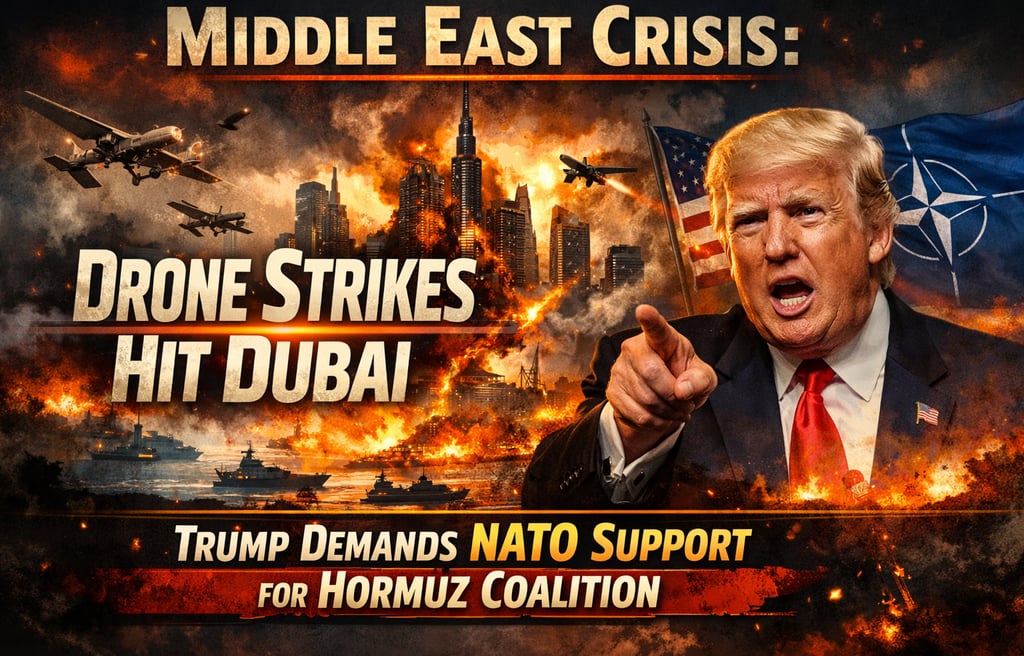
DUBAI/TEHRAN — The Middle East conflict reached a volatile new phase on Monday as drone strikes targeted critical infrastructure in the United Arab Emirates, while U.S. President Donald Trump issued a stern ultimatum to NATO allies to assist in reopening the blockade at the Strait of Hormuz.
Drone Attacks Strike Dubai and Fujairah
In the early hours of Monday, March 16, a suspected Iranian drone strike hit a fuel tank in the vicinity of Dubai International Airport (DXB). The resulting fire led to a temporary suspension of all flights at one of the world’s busiest aviation hubs. While Dubai authorities confirmed the fire was gradually contained and flight operations have begun to resume, the incident has sent ripples of panic through the global travel and logistics sectors.
Simultaneously, reports emerged of a separate strike on the Fujairah oil industry zone in the UAE. These attacks underscore Tehran's strategy of retaliating against regional neighbors that host U.S. military installations, following weeks of sustained U.S.-Israeli bombardment of Iranian territory.
Trump’s Ultimatum to NATO and Allies
Speaking from Washington, President Donald Trump ramped up pressure on international partners to join a naval coalition aimed at policing the Strait of Hormuz. The strategic waterway, responsible for 20% of the world’s oil and gas transit, remains effectively closed to vessels from the U.S., Israel, and their "allies."
Trump warned of a "very bad future for NATO" if member states fail to contribute warships to the escort mission. "Other countries must take care of Hormuz," Trump stated, suggesting that the U.S. would no longer shoulder the burden of securing energy routes for nations that refuse to participate in the military campaign.
However, the call for a coalition has met with significant resistance. Germany and Greece have both officially declined military involvement, with Berlin stating the conflict has "nothing to do with the NATO alliance." Similarly, Japan and Australia have indicated they have no current plans to dispatch naval assets to the region.
The Ground War and Leadership Uncertainty
In Iran, the Israeli Defense Forces (IDF) reported a "wide-scale" wave of strikes targeting military infrastructure in Tehran. This follows reports that an aircraft linked to the late Supreme Leader Ali Khamenei was destroyed at Mehrabad Airport.
Intelligence reports suggest a power vacuum may be forming within the Islamic Republic. While Mojtaba Khamenei has been named as the successor, U.S. and Israeli intelligence assess that he may have been wounded in early strikes, leaving the Islamic Revolutionary Guard Corps (IRGC) to "call the shots" on the ground.
India’s Diplomatic Balancing Act
Amidst the escalating military posture of the West, India has emerged as a key diplomatic mediator. External Affairs Minister S. Jaishankar confirmed that New Delhi is engaged in direct talks with Tehran to ensure safe passage for Indian-flagged vessels. These negotiations have already seen some success, with two Indian gas tankers allowed to transit the Strait of Hormuz over the weekend—a move seen as a victory for "diplomacy over deployment."
Economic Fallout
The prolonged closure of the Strait is already being felt globally.
Energy: Crude oil prices remain volatile, with the IEA preparing to release 400 million barrels of emergency reserves.
Food Security: International leaders have warned that a lack of fertilizer shipments through the Gulf could trigger a global food crisis by 2027.
Internal Displacement: The WHO estimates over 700,000 people have been displaced in Lebanon and 100,000 in Iran since the conflict began on February 28.
As the war enters its third week, both Washington and Tehran appear far from the negotiating table. "Iran is prepared to continue the war wherever it is," warned Iranian Foreign Minister Abbas Araghchi, signaling that the "regional conflagration" shows no signs of cooling.
Contact
Reach out for news tips or inquiries.
Phone
+91-6003712563
© 2025. All rights reserved.