
Escalation in West Asia: Iran Launches Cluster Warhead Strikes on Tel Aviv Following Assassination of Security Chief
WORLD
3/18/20262 min read
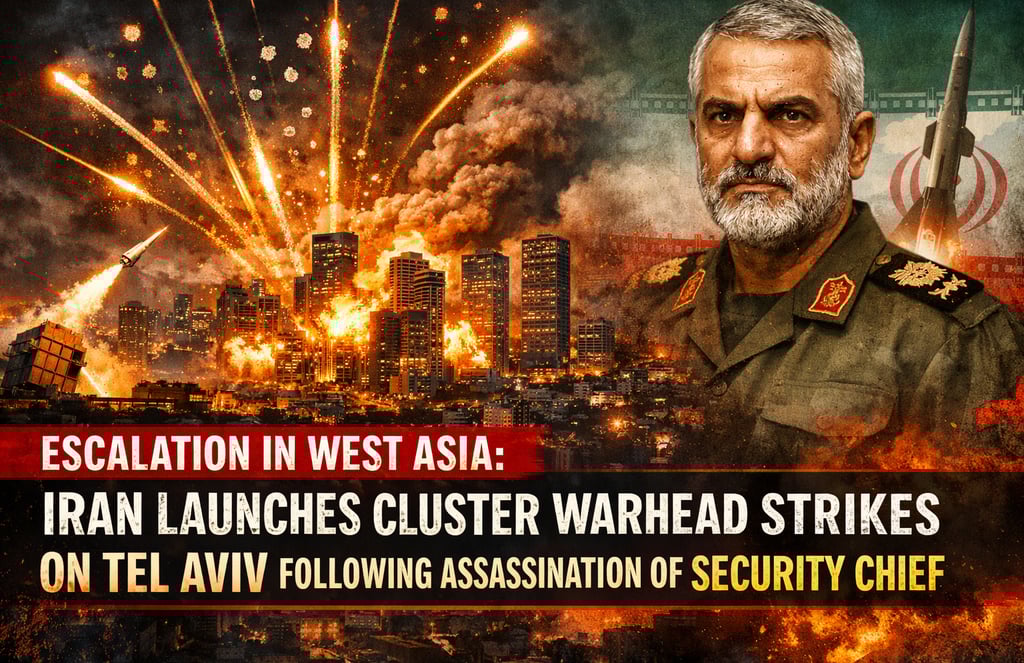
TEL AVIV – The conflict in the Middle East reached a perilous new flashpoint overnight as Iran targeted the densely populated city of Tel Aviv with missiles carrying cluster warheads. The strikes come as direct retaliation for the Israeli assassination of Iran’s Supreme National Security Council Secretary, Ali Larijani.
The Strike and Casualties
According to Iranian state television, the missile barrage was a response to a Monday night strike by Israel that killed Larijani, his son, and his deputy, Alireza Bayat.
Israeli defense officials confirmed that the overnight attack on Tel Aviv killed two people, bringing the total death toll within Israel to 14 since the current war began in late February. The use of cluster warheads—which disperse numerous smaller explosives over a wide area—made interception efforts by the Iron Dome and other defense systems significantly more difficult.
Political Defiance in Tehran
In Tehran, the newly appointed Supreme Leader, Mojtaba Khamenei, has reportedly taken a hardline stance. In his first foreign-policy briefing since succeeding his father, Khamenei rejected international proposals for a ceasefire or de-escalation with the United States.
A senior Iranian official quoted Khamenei as saying that "it is not the right time for peace" until the U.S. and Israel "accept defeat and pay compensation."
U.S. Involvement and the Global Fallout
The United States military continued its operations along the Iranian coastline, specifically targeting anti-ship missile sites near the Strait of Hormuz. President Donald Trump, speaking on the conflict, castigated NATO allies for their lack of military support but asserted that the U.S. no longer "needs" their assistance due to recent "military success."
The humanitarian and economic toll of the three-week-old war is mounting rapidly:
Casualties: Human rights group HRANA estimates over 3,000 people have been killed in Iran. Over 900 deaths have been reported in Lebanon since Israeli operations began there on March 2.
Oil Crisis: The Strait of Hormuz remains largely closed, causing global oil prices to surge by 45% since February 28. This has sparked fears of a global inflation spike.
Aviation: Most Middle Eastern airspace is currently closed, leading to mass flight cancellations and soaring jet fuel costs.
Food Security: The World Food Programme warned that tens of millions could face acute hunger if the conflict persists through June.
Nuclear Concerns
As the fighting intensifies, the International Atomic Energy Agency (IAEA) has called for "maximum restraint" after a projectile landed near the Bushehr nuclear power plant. While no damage was reported, IAEA Chief Rafael Grossi warned of the catastrophic risk of a nuclear accident in a combat zone.
Israel and the U.S. maintain that dismantling Iran’s nuclear program remains a primary objective of their campaign, which has already claimed the lives of several top Iranian officials.
Contact
Reach out for news tips or inquiries.
Phone
+91-6003712563
© 2025. All rights reserved.