
Blood Moon to Grace the Skies on March 3, 2026: Only Total Lunar Eclipse of the Year
WORLD
2/25/20262 min read
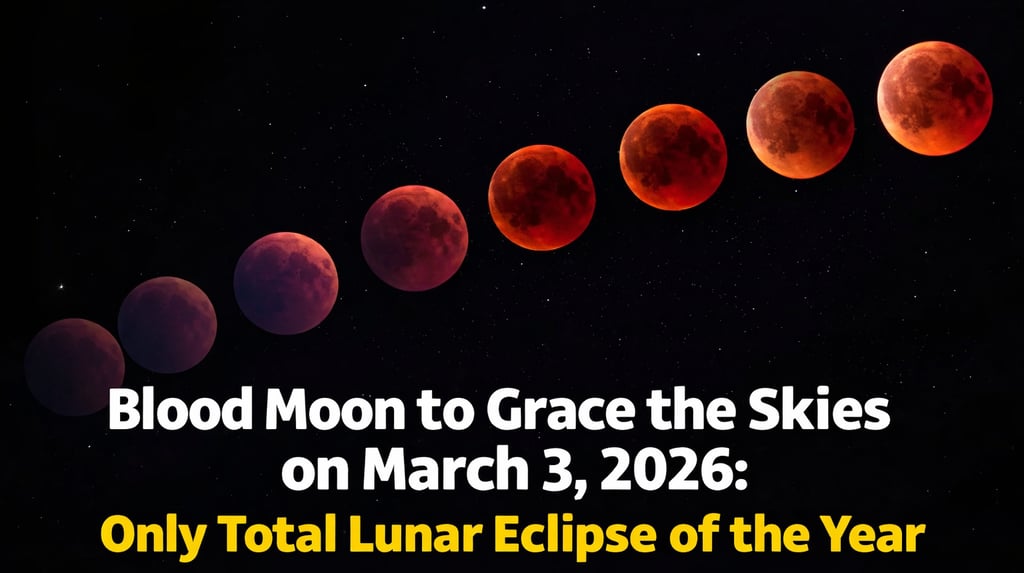

A spectacular celestial event is set to captivate skywatchers worldwide as a Total Lunar Eclipse, popularly known as a Blood Moon, occurs overnight on March 2–3, 2026. This will be the first and only total lunar eclipse of 2026, offering nearly an hour of dramatic red lunar glow.
What Will Happen?
During a total lunar eclipse, the Earth moves directly between the Sun and the Moon, casting its shadow completely over the lunar surface. As the Moon passes entirely through Earth’s darkest shadow — the umbra — it takes on a deep reddish hue.
This striking “Blood Moon” effect occurs because Earth’s atmosphere bends and filters sunlight, allowing only red wavelengths to reach the Moon.
The total phase, known as totality, will last approximately 58 minutes, during which the Moon will appear coppery red in the night sky.
When to Watch
The eclipse will begin late on March 2 and continue into the early hours of March 3, depending on local time zones. Most of the dramatic total phase will occur before dawn in regions where the eclipse is fully visible.
Skywatchers are advised to check local astronomical timing apps or observatory websites for exact phase timings in their area.
Where It Will Be Visible
The eclipse will be visible across large portions of the globe where the Moon is above the horizon at night.
Complete Total Eclipse Visible In:
Western parts of North America
Australia and New Zealand
Eastern Asia, including Japan, Korea, and eastern China
Partial Eclipse Visible In:
Central Asia
Parts of eastern South America
Not Visible In:
Most of Europe
Most of Africa
Visibility in India
In India, viewing conditions will vary by region:
Northeastern India may witness the Moon rising while still in totality, offering a glimpse of the red Blood Moon phase.
Most other parts of India are expected to see only a partial eclipse after moonrise.
Safe and Easy to Observe
Unlike a solar eclipse, a lunar eclipse is completely safe to observe with the naked eye. No special glasses or protective equipment are required.
However, binoculars or telescopes can enhance the experience by offering a closer look at Earth’s shadow gradually covering the Moon’s surface.
Why It Matters
Total lunar eclipses are among the most accessible astronomical events, visible from anywhere on Earth’s night side. While not extremely rare, having only one total lunar eclipse in a year makes this event particularly noteworthy.
After March 2026, the next widely visible total lunar eclipse for many regions will not occur until late 2028.
As anticipation builds, astronomy enthusiasts and casual observers alike are preparing to look up and witness one of nature’s most breathtaking nighttime spectacles — the glowing red Moon suspended in the pre-dawn sky.
Contact
Reach out for news tips or inquiries.
Phone
+91-6003712563
© 2025. All rights reserved.